October 07, 2025 - 1 comments
Over 8,000 bars, restaurants, and wine cellars around the world where you can drink natural wine!
Natural Wine Market Analysis: Growth Trends and Global Expansion: 2016 to 2024.
Between 2021 and 2024, the number of venues offering natural wine worldwide rose from 5,000 to over 8,000, representing 60% growth that reflects the rapid expansion of this market. This growth provides an opportunity to analyze and report on everything we know today about natural wine: its growth trends, its international expansion, but also its impact and growing influence on the world of wine. Here's what's happening in the world of wine, and how natural wine is transforming it forever.
🗂️ The previous study, 5,000 places to drink natural wine around the world, was published on November 14, 2021, and differs slightly from this one in its structure and data.
1. Current state of the market for venues offering natural wine.
Let's all raise a glass! With the emergence of natural wine, we are witnessing a real miracle in motion. Just three years ago, Raisin listed around 5,000 venues offering natural wine. By the end of 2024, this figure had exceeded 8,000 venues, representing a 60% increase that marks a welcome change in the world of wine.
What's fueling this enthusiasm?
The answer can be summed up into three words: authenticity, human scale, and local distribution. Increasingly, consumers are opting for products from smaller, local farms that prioritize ecological, authentic, and passionate agriculture. As a result, they are frequenting bars, wine shops, restaurants, and hotels/Bnbs that support these farms, causing an exponential growth in these venues. Today, each glass represents more than just the drunk wine; it represents conviviality, intentional choices, and an authentic connection with the world around us.
Explanatory Factors:
- 1 - Environmental awareness: Environmentally friendly practices are increasingly appealing to consumers, especially in urban areas.
- 2 - Small-scale production and distribution: Small estates produce limited quantities and are often distributed mostly locally. This is a key differentiating factor in a world that is rapidly becoming standardized.
- 3 - Premium positioning: Natural wine is increasingly perceived as a premium, allowing for higher margins for both producers and distributors. However, since COVID, the surge in raw material costs has led to a general increase in prices that negates many of these margins.
- 4 - Digital transformation: Platforms (such as Raisin) direct consumers towards venues and producers that share common values, thereby accelerating market growth.
📝 With an average venue growth rate of 20% a year between 2021 and 2024 on Raisin, natural wine continues to gain market share, driven by demands for sustainability, authenticity, and environmental responsibility. This success is all the more remarkable given that, over the same period, consumption of conventional wine fell by 9%, according to data from the OIV.
2. Countries with the highest number of bars, restaurants, wine shops, and accommodations.
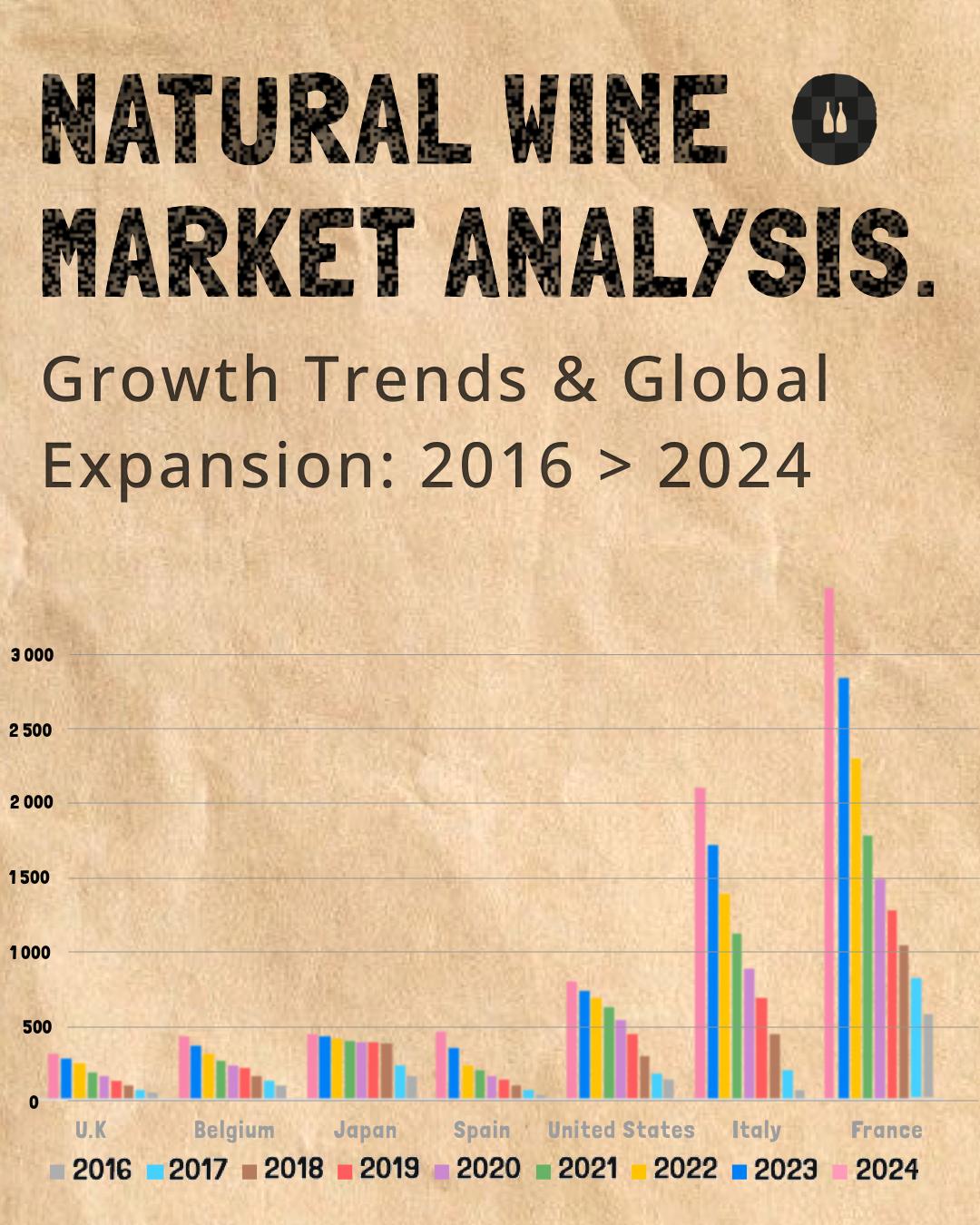
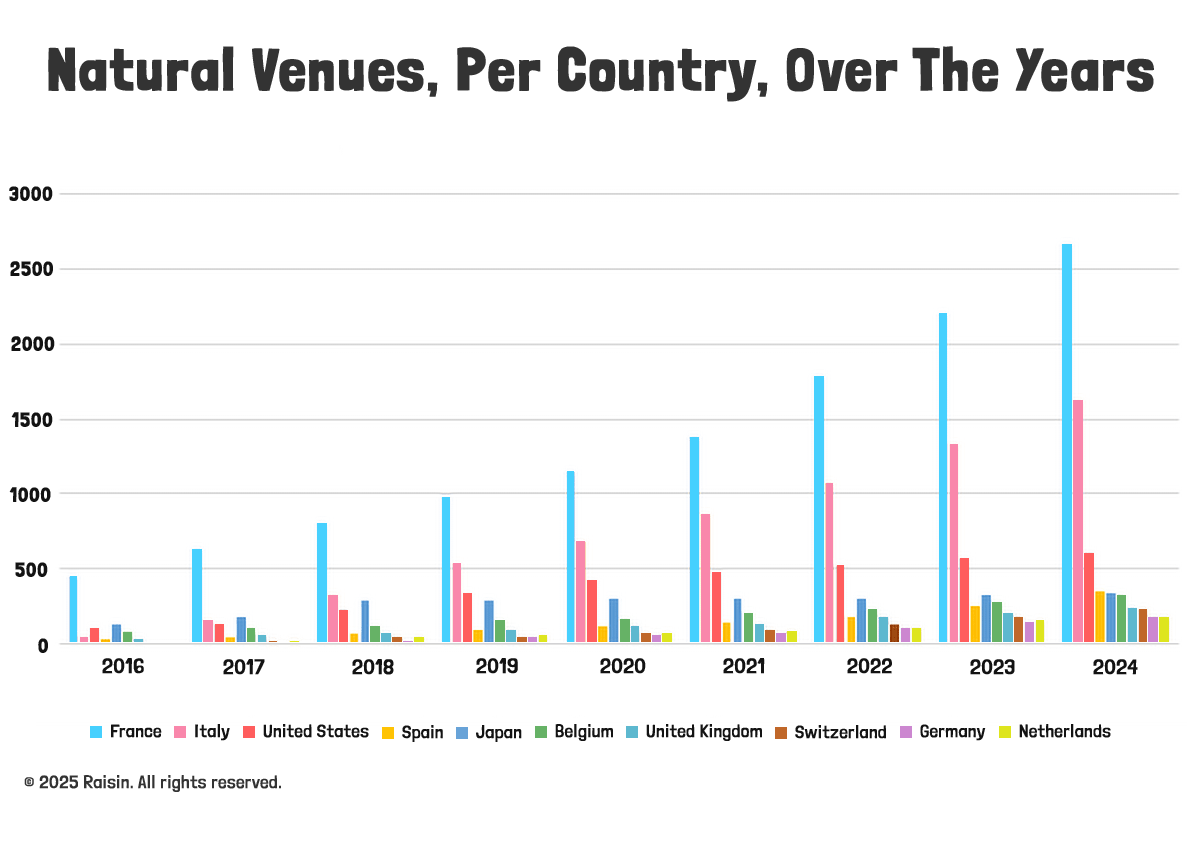
10 countries with the highest number of natural venues:
Italy 🇮🇹 closely follows France, with exceptional artisanal products that represent its many regions and its producers who maintain a local, authentic identity.
The U.S. has felt momentum, especially on the East Coast: a new wave of organic farming is sweeping through the region, driven by the growing demand for organic products and where a new wave of eco-friendly gastronomy is attracting curious customers.
Belgium 🇧🇪, often regarded as a beer country, boasts a surprising and exceptional density of venues dedicated to natural wine.
Germany 🇩🇪 and Switzerland 🇨🇭 are experiencing steady and solid growth from 2016 to 2024.
Japan 🇯🇵's progress may seem slower at the national level; however, major cities such as Osaka are showing particular energy.
Everywhere, one thing remains constant: natural wine thrives where authenticity, curiosity, and taste come together.
Many countries are showing a real growth and rise in popularity of natural wine. These emerging markets include South Korea 🇰🇷 (59 venues, including 39 in Seoul), Poland 🇵🇱 (67 venues), Mexico 🇲🇽 (34 venues), and Brazil 🇧🇷 (27 venues). Even smaller countries, such as Iceland 🇮🇸 (5 venues), the Philippines 🇵🇭 (3 venues) and Costa Rica 🇨🇷 (3 venues), demonstrate the emerging global success of natural wine production and consumption.
| Country | 2016 | 2017 | 2018 | 2019 | 2020 | 2021 | 2022 | 2023 | 2024 |
|---|---|---|---|---|---|---|---|---|---|
| France 🇫🇷 | 446 | 633 | 806 | 977 | 1147 | 1375 | 1781 | 2190 | 2655 |
| Italy 🇮🇹 | 46 | 152 | 334 | 535 | 684 | 863 | 1070 | 1330 | 1623 |
| USA 🇺🇸 | 105 | 138 | 227 | 345 | 421 | 477 | 527 | 571 | 612 |
| Spain 🇪🇸 | 31 | 52 | 77 | 101 | 124 | 145 | 180 | 259 | 351 |
| Japan 🇯🇵 | 128 | 179 | 287 | 298 | 304 | 306 | 310 | 323 | 336 |
| Belgium 🇧🇪 | 81 | 106 | 127 | 158 | 175 | 202 | 235 | 283 | 331 |
| United Kingdom 🇬🇧 | 36 | 56 | 70 | 101 | 126 | 139 | 186 | 208 | 238 |
| Switzerland 🇨🇭 | 16 | 27 | 43 | 53 | 72 | 94 | 133 | 180 | 231 |
| Germany 🇩🇪 | 8 | 15 | 29 | 53 | 61 | 78 | 110 | 151 | 187 |
| Netherlands 🇳🇱 | 13 | 23 | 45 | 55 | 70 | 90 | 115 | 153 | 179 |
📝 In 2024, France 🇫🇷 remained the undisputed leader, with a growing number of venues dedicated to natural wine across the country, slowly approaching 3,000.
10 countries with the highest growth rates:
In regards to venue growth, let's first focus on the figures that have seen a minimum increase of 1,000% (yes, the growth really is that big) between 2016 and 2024. We are witnessing jaw-dropping success in Italy 🇮🇹 (3428.3% ⬆️), Germany 🇩🇪 (2237.5% ⬆️), Switzerland 🇨🇭 (1343.8% ⬆️), the Netherlands 🇳🇱 (1276.9% ⬆️), and Spain 🇪🇸 (1032.3% ⬆️). In comparison, with an increase in venues of 162.5% ⬆️, Japan 🇯🇵 may appear to be lagging behind a little, but this is far from the case. At the same time, France 🇫🇷 leads the way in the number of venues, with 2,655 venues and a percentage increase of 495.3% (+495.3% ⬆️) between 2016 and 2024. In terms of growth from 2023 - 2024, Spain 🇪🇸 (+35.5%⬆️) leads the way, followed by Switzerland 🇨🇭(+28.3% ⬆️), Germany (+🇩🇪23.8%⬆️), Italy 🇮🇹 (+22%), and finally France 🇫🇷 (+21.2% ⬆️) in fifth place.
This is unsurprising: European wine-producing countries have also historically been major wine-consuming countries, given that many of these European countries have cultural and historical roots to wine.
_LgsOSdE.gif)
The 10 countries where natural wine consumption in bars, restaurants, and wine shops is growing the fastest:
Lastly, we quickly note the 10 countries where natural wine consumption in bars, restaurants, and wine shops is growing the fastest.
| Growth by country | % increase in venues: 2023-2024 | % increase in venues: 2021-2024 | % increase in venues: 2016-2024 | Compound Annual Growth Rate (CAGR) since 2016: |
|---|---|---|---|---|
| France 🇫🇷 | 21.2% | 93.1% | 495.3% | 21.92% |
| Italy 🇮🇹 | 22% | 207.6% | 3428.3% | 48.58% |
| United States 🇺🇸 | 7.2% | 28.3% | 482.9% | 21.64% |
| Spain 🇪🇸 | 35.5% | 142.1% | 1032.3% | 30.95% |
| Japan 🇯🇵 | 4% | 9.8% | 162.5% | 11.32% |
| Belgium 🇧🇪 | 17% | 63.9% | 308.6% | 16.93% |
| United Kingdom 🇬🇧 | 14.4% | 71.2% | 561.1% | 23.35% |
| Switzerland 🇨🇭 | 28.3% | 145.7% | 1343.8% | 34.53% |
| Germany 🇩🇪 | 23.8% | 139.7% | 2237.5% | 41.93% |
| Netherlands 🇳🇱 | 17% | 98.9% | 1276.9% | 33.83% |
3. Urban Hubs for Natural Wine
Top 5 cities (by venue count) in 2021:
| Top 5 cities (by venue count) in 2024:
|
Paris remains the undisputed leader with continued significant growth between 2021 and 2024, followed by New York City, Rome, Barcelona and Brussels, which are rapidly gaining ground. London has reached a plateau, with an increase of only two venues from 2021-2024 (98 → 100). Cities such as Antwerp are showing impressive growth, surpassing traditional natural wine capitals, which is a testament to their growing appeal. In Japan, Osaka has established itself as an important Asian hub with 34 venues offering natural wines.
When comparing the evolution of venues dedicated to natural wine between 2021 and 2024, there is a noticeable change in distribution. Natural wine is now establishing itself in restaurants, highlighting its growing role as an integral part of broader culinary experiences. Yes, we repeat it tirelessly: travel, gastronomy, and wine go hand in hand.
2024: The 30 best cities for drinking natural wine:
💡 NOTE: Many venues belong to more than one of the following categories: bar, wine shop, and/or restaurant.
| City | Count of Bars | Count of Wine Shops | Count of Restaurants | Total |
|---|---|---|---|---|
| Paris | 84 | 122 | 393 | 599 |
| New York City | 64 | 53 | 66 | 183 |
| Rome | 34 | 15 | 81 | 130 |
| Barcelona | 27 | 7 | 78 | 112 |
| Brussels | 42 | 25 | 37 | 104 |
| London | 28 | 15 | 57 | 100 |
| Tokyo | 39 | 13 | 43 | 95 |
| Amsterdam | 11 | 22 | 54 | 87 |
| Quebec | 31 | 1 | 53 | 85 |
| Lyon | 7 | 16 | 61 | 84 |
| Copenhagen | 18 | 12 | 58 | 88 |
| Milan | 14 | 5 | 54 | 73 |
| Berlin | 24 | 13 | 32 | 69 |
| Marseille | 4 | 20 | 45 | 69 |
| Montréal | 14 | 0 | 54 | 68 |
| Toulouse | 6 | 12 | 40 | 58 |
| Nantes | 7 | 16 | 36 | 59 |
| Geneva | 27 | 12 | 14 | 53 |
| Turin | 14 | 4 | 35 | 53 |
| Bordeaux | 7 | 15 | 35 | 57 |
| Anvers | 7 | 4 | 34 | 45 |
| Nice | 6 | 2 | 33 | 41 |
| Los Angeles | 16 | 11 | 17 | 44 |
| Venice | 10 | 2 | 31 | 43 |
| Gand | 11 | 3 | 29 | 43 |
| Séoul | 25 | 5 | 14 | 44 |
| Bologna | 10 | 2 | 28 | 40 |
| Osaka | 12 | 3 | 22 | 37 |
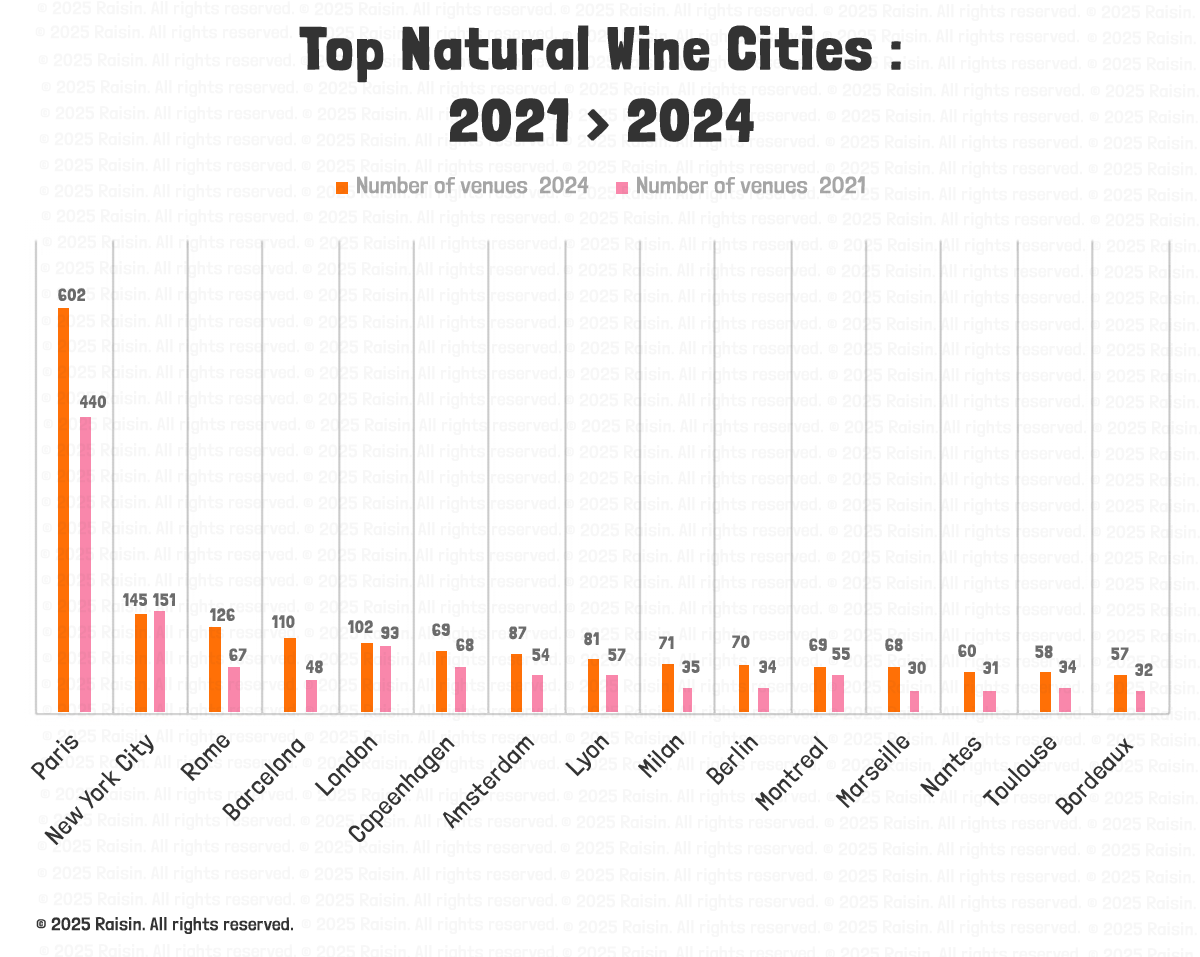
The largest natural wine cities between 2021 and 2024
No. 1 - Paris has experienced explosive growth, from 440 venues in 2021 to 599 in 2024 (+159 venues, or a 36% increase), but this growth does not reflect the significant change in the type of venues we see growing. In Paris, the number of natural wine bars on Raisin has fallen from 157 to 84 and the number of wine shops from 169 to 122. At the same time, the number of restaurants on Raisin has risen from 282 to 393. Paris offers the greatest diversity of venues globally on Raisin, with around 200 bars, 200 wine shops, and 300 restaurants spread across 20 different arrondissements, mainly concentrated in the center and east of the city. It is interesting to note that the concentration of natural wine consumption in the northeast quarter of Paris is inversely proportional to the price per square meter and the income of Parisians, even though the average price of a bottle of natural wine is higher than the average price of a bottle of conventional wine. According to a study conducted on a representative sample of Raisin users in Q1 2025, residents in these areas buy an average of 7 bottles per month for home consumption, at an average cost of €18.39 per 75cl bottle. The weighted average price “all channels 2024” (including wine merchants) is around €4.20 per 75cl bottle for conventional wine (data from FranceAgriMer, Circana, and PropulsebyCA), largely driven by sales in supermarkets.
#2 - A distant second, New York City also experienced significant growth, growing from 151 to 183 venues (+32 venues, or an increase of 21%), and the number of wine shops increased considerably, from 38 to 53 venues. Bars increased from 50 to 64, while restaurants decreased slightly, from 98 to 88. The increase in the price of a bottle of wine on New Yorkers' purchasing power has probably had a significant impact on restaurant consumption, which was already well under attack during Covid-19.
#3 - Just behind, in third place, the number of venues in Rome saw a substantial increase, rising from 67 to 130 (+63 venues, or an increase of 94%). Rome has almost doubled the number of restaurants, from 44 to 81 venues, while the number of wine bars has decreased from 32 to 15 and the number of bars from 44 to 34. In this sense, the trend in Rome is very similar to that in Paris, where restaurants are becoming the most common type of establishment.
#4 - In fourth, we have the touristic and gastronomic city of Barcelona with 112 bars, restaurants, and wine cellars. The number of venues offering natural wines has more than doubled in the city, from 48 in 2021 to 112 in 2024, an increase of 133%. Once again, we see the same phenomenon as in Paris and Rome. The number of bars has increased slightly, from 24 to 27 venues (+12.5%), while the number of wine shops has decreased, from 12 to 7 venues (-41.7%). Restaurants, on the other hand, saw a very significant increase, rising from 33 to 78 venues (+136.4%). This destination has everything it needs to continue growing: culture, history, gastronomy, sea and sun, as well as affordable wine prices. Surprisingly, in comparison, Madrid remains relatively modest, with a total of 34 venues, far behind other European capitals, which is in itself an anomaly for which there is no obvious reason. This leads us to believe that opening a bar, restaurant, or wine cellar in Madrid is currently a safe bet (just a suggestion), so go for it, Madrileños!
#5 - Brussels ranks fifth and is a unique city in many ways. Not only is it considered one of the best cities in the world for beer tasting, but Belgium is also a fantastic country for natural wine lovers, even though it is not historically a major wine producer (there are only eight natural winemakers in Belgium). Brussels offers an incredible and varied selection of venues of all kinds. With 12 bars, 25 wine shops, and 37 restaurants, get ready to quench your thirst and satisfy your hunger. It is the ideal destination for all food and wine lovers who want to spend a relaxing weekend in the European capital.
The sharp rise in restaurant consumption is also due to the fact that natural wine has a positive impact on the restaurant industry, extending well beyond its own category. Natural wine is now a powerful marker of high-quality sourcing, favoring local, seasonal, and often organic products from artisans. Chefs and sommeliers now work together to align a consistent experience and sourcing from glass to plate.
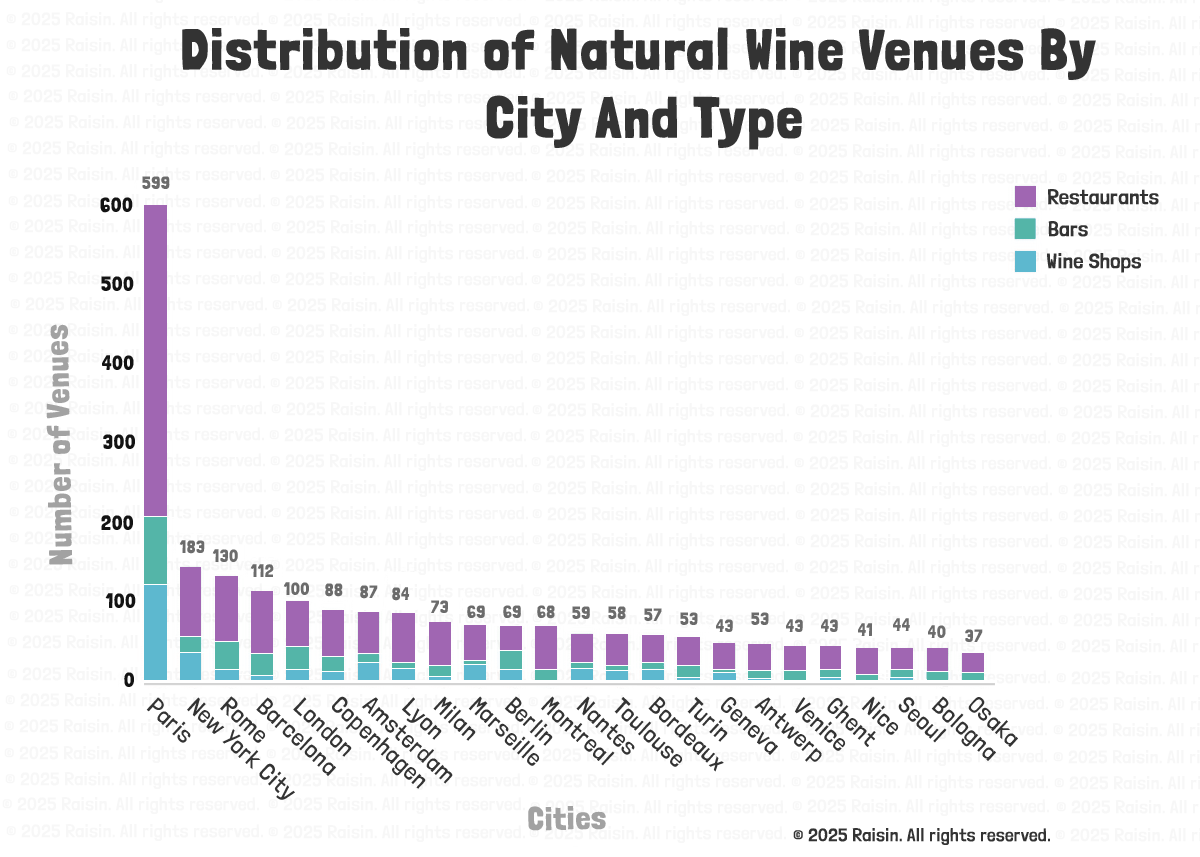
📝 One constant in the natural wine movement is the concentration in urban and cosmopolitan cities, like the ones above. Paris remains the central urban center of the natural wine movement, while other cities are gaining ground. In New York and Rome, restaurants are becoming the main event. In Barcelona and Brussels natural wine is booming, and attracting a cosmopolitan audience.
4. Paris, the world capital of natural wine, continues to grow!
Paris districts - Number of venues (2024)
Ranked by number of venues
| 2024 Arrondissement of Paris | Number of venues |
|---|---|
| 11th District | 108 |
| 10th District | 64 |
| 18th District | 54 |
| 9th District | 43 |
| 20th District | 40 |
| 3rd District | 34 |
| 12th District | 30 |
| 19th District | 29 |
| 6th District | 24 |
| 17th District | 24 |
| 5th District | 19 |
| 2nd District | 18 |
| 14th District | 17 |
| 1st District | 12 |
| 13th District | 10 |
| 15th District | 10 |
| 16th District | 9 |
| 7th District | 8 |
| 4th District | 7 |
| 8th District | 6 |
In 2021, Paris already dominated with 440 venues on Raisin, three times more than New York and four times more than London. Four years later, it remains the go-to destination for natural wine, with 599 venues listed in 2024. It is a dream city for anyone who wants to immerse themselves in the world of natural wines, and it is important to note that not only is the natural wine movement continuing to grow in Paris, it is showing a direct contrast to any typical signs of saturation one would see. The venues are concentrated in the east of Paris, around Oberkampf, République, and Canal Saint-Martin, where young creatives and enthusiasts mingle.
Prices have risen, reflecting higher raw material costs and inflation. It is becoming rare to find a bottle for less than €15 in wine shops, while in bars you can expect to pay at least €35 to €45, and in restaurants the minimum is increasingly between €55 and €70. There is no statistical evidence to support this claim, it is more of an observation made by the Raisin team from places that we frequent in Paris, yet we can assure you that we are active analysts of this phenomenon. We, just as consumers, are increasingly disheartened by this.
We know that cavists and sommeliers alike know that selling two bottles at €50 is more profitable than selling one bottle for €60. So beyond just being a flawed economic calculation, we deplore the fact that these prices contribute to increasing the economic difficulties faced by all market players. The rise in prices is undeniably a deterrent for consumers, even those who prioritize quality over quantity. Of course, we remind everyone that consumption should always be in moderation, and with responsibility for ourselves and others always.
The 11th arrondissement remains the epicenter of the movement, with 108 venues in 2024 compared to 91 in 2021. At the same time, the 9th arrondissement has established itself as a second major hub. The districts located to the west (6th, 7th, 15th, 17th) continue to play only a marginal role, generally home to one or two flagship venues. This represents a significant opportunity for future venues.
To conclude, none of those who started drinking natural wine in the early 1990s would have believed how big this movement would become. In the early 2000s, Jura winegrowers were scouring Parisian venues to sell their wines. At the time, no one wanted them, whereas today the wines of Domaine de la Tournelle, for example, are sought after by wine lovers around the world. It has therefore been a long and arduous journey, fraught with obstacles, and being a winemaker has become even more complex today.
5. New York venues by neighborhood.
| 2024 Borough (NYC) | Location | Number of Venues |
|---|---|---|
| BROOKLYN (KINGS COUNTY) | ||
| Brooklyn | Brooklyn | 69 |
| Brooklyn | Kings County | 11 |
| Brooklyn | Queens County | 3 |
| Total Brooklyn | 83 | |
| Total Manhattan | 69 | |
| Total Queens | 2 | |
| Total Bronx | - | |
| Total Staten Island | - | |
| Venues outside NEW YORK CITY (Other NEW YORK cities and towns present on Raisin) | ||
| Hudson, Buffalo, Troy, Beacon, Kingston, Accord, Coxsackie, Germantown, Greenport, High Falls, Livingston Manor, Marlboro, Montauk, Saugerties, Town of Andes, Hunter Village. | 30 | |
| GRAND TOTAL | 184 | |
New York continues to show strong growth, particularly in Brooklyn and Manhattan, with increasing numbers in Queens. The West Village is becoming the next hot spot, showing that demand continues to spread throughout the city. The figures show that natural wine, particularly in the United States, is not a “fad” or a “trend”: it is now deeply rooted in the city's culture and gastronomic scene. In many restaurants in downtown New York, natural wines are part of the standard offering, and natural wine bars are considered gateways to discovering lively neighborhoods and local recommendations. This movement is particularly driven by young urban consumers, who consider natural wine to be a cultural marker and an identity choice, influencing the character of iconic neighborhoods. Industry veterans note that natural wines are now more widely accepted and understood, even among traditional consumers.
On a national scale, the East Coast has roughly twice as many venues as the West Coast, highlighting regional differences in adoption and reinforcing New York's role as a hub of the movement. Beyond its obvious cultural influence, natural wine has also experienced significant economic growth. New York is the second most important city for natural wine after Paris. Chefs and sommeliers are incorporating natural wine into their cuisine and wine lists, thereby fueling both cultural and economic prosperity.
Taken together, these developments show that natural wine in New York is shaping the identity of places, stimulating the local economy, and strengthening the city's reputation.
6. Natural wine: a maturing market
Natural wine has experienced phenomenal growth over the past decade; since 2024, the market has been taking a breather due to several factors such as: the increase in the number of players (producers, agents, importers, etc.), greater price competition, and less tolerance for “flaws”.
While some export channels are slowing down, demand remains strong in cities with a rich history of wine and consistent pricing. We can therefore talk about a market correction: the movement is maturing and a few adjustments are necessary in order to continue to convince as many people as possible of the virtues of these wines. The future lies in continuing to respect the environment and offering prices that are accessible to as many people as possible through the use of new containers (bag-in-box, key keg, ultra-light bottles, etc.), state of the art hygiene in the cellar, and welcoming, open venues that practice open conversations about natural wine.
Community values continue to attract conscious consumers seeking transparency, authenticity, and sustainability. In addition, the movement has also highlighted unique types of wines such as pét-nats or orange wines, broadening taste horizons while fueling a powerful identity.
Large cities have driven this growth, but now secondary markets are taking over. Nowadays, opening an establishment in the 11th arrondissement of Paris without offering natural wine on the menu? Complicated. Consumers are willing to pay more for artisanal, low-intervention wines, and this momentum is merging with the slow-food, farm-to-table, and locavore movements that consumers have been waiting for. Natural wine has become a decisive asset, a lasting force in the wine industry.
Despite everything, the question remains: what is natural wine? Because yes, debates surrounding the definition of natural wine, quality control, and consistency persist. This questioning, along with the absence of a clear definition, are integral pieces to its evolution rather than an existential threat, in fact. While there are many variations in how wine is made, the goal remains the same: to make wine from fermented grapes, sometimes with a little sulfur. The confusion has the benefit of keeping large distributors (chains and supermarkets) away from the movement. It is difficult to sell a product that is so simple in its composition without pointing the finger at the other bottles lined up on the shelves. Doing so always tends to beg the question from consumers: “If there is nothing but grapes in this wine, what is in the wine we buy at the supermarket?”
7. What are the development trends for the coming years?
What matters to us are not farmers who have reduced nature to a mere source of income, forgetting that they themselves are part of it. No. What we want is to see the world evolve, and if possible, in the right direction. We want to eat better, drink better, and ultimately be happier. That's why we want to share with you the trends we've observed in cities and countries where, in our opinion, the future is already taking shape.
Beyond the obvious cities such as Berlin, Seoul, and Montreal, where youth, cultural diversity, and gastronomy intersect, we are seeing that it is now hybrid venues that are proving most appealing: cellar-bar-kitchen, inns combining morning coffee, local cuisine, and glasses of natural wine. Acoustic evenings, tastings, mini-festivals, and trade shows are also popular: all opportunities for sharing and community that enthusiasts seek.
The most promising countries:
- Italy: With annual growth of 49% since 2016 and +22% year-on-year, Italy still has enormous potential, well beyond its established city centers.
- Germany: +42% annual growth since 2016 and +23.8% between 2023 and 2024, Germany has a strong and sustainable interest in the movement.
- Switzerland: With a 35% annual growth rate and a more recent 28.3% growth, consumer interest is evident.
- Spain: +35.5% growth in one year, Spain's history as a deeply rooted wine culture and a market of young urban consumers creates an environment ripe for the taking.
Up and coming cities:
- Madrid: a natural wine scene that is still young and ready to explode.
- Berlin: a rapidly expanding audience.
- Montreal: a strong foothold in the local food scene.
- Seoul: 39 venues already, and huge potential.
- Secondary Italian cities: Rome has exploded, but smaller towns are ready to follow.
Types of venues to prioritize:
- Hybrids: combining a wine cellar, bar, and light refreshments is the current formula for staying within a tight budget.
- Integration with accommodation: 181 venues already offer accommodation, opening the door to wine tourism and, of course, providing a place to enjoy natural wine.
- Educational spaces: workshops, tastings, and educational activities attract an increasingly curious audience.
8. The environmental impact of natural wine
In 2022, agriculture consumed 3.70 million tons of active substances (47.5% herbicides, 29.5% insecticides, 17.5% fungicides, 5.5% others), up 4% from 2021 and double the amount used in 1990. The situation is worsening, despite the public policies that have been put in place...
Vineyards cover only 3.5% of European agricultural land but use 15% of pesticides. In France, 20% of treatments are concentrated on 3.7% of the land. Every percentage point of market share gained by natural wine (including organic and/or biodynamic agriculture) means that much less pesticide use. If its share reached 5%, pesticide use in French viticulture would decline by the same amount (a disconcerting truth), just as consumers would avoid a significant amount of pesticides, additives, and preservatives. Today, around 22% of French vineyards are certified organic or in the process of conversion (compared to 6% in 2010). This spectacular growth reflects the growing demand for products that align with sustainable values. Drinking less but drinking better is the only possible future for wine.
Key Statistics:
- In France, the expansion of venues offering natural wines goes hand in hand with the growth of organic certification of vineyards, which has risen from 6% in 2010 to around 22% today.
- In Italy, with 739 natural vineyards out of 30,000 farms, natural wine accounts for 2.50% of Italian estates.
- According to Eurostat, out of 75,510 wine farms in France, 1,536 are winemakers recommended by Raisin. This represents 2.03% of all producers, evidence of a movement which, although a minority, is already making its mark.
Conclusion
It is always presumptuous to attempt to provide an accurate picture of a movement as rich and varied as that of natural wine. In this document, and in the absence of official data, we shed light on the main angle of the number of venues that offer at least 30% natural wine, and the number of winemakers that we recommend worldwide, cross-referencing them with data from various press articles and published works.
While global wine consumption is declining, natural wine continues to grow, bucking the trend. This trend reflects a broader shift: consumers want to ensure the sustainability and authenticity of what they consume through genuine respect for the environment. Italy, Germany, and Spain, as well as cities such as Barcelona, Berlin, and Montreal, are expected to fuel strong growth in the coming months and years.
The current victory of natural wine, as symbolic as it may seem in terms of numbers or volume of bottles, is being played out elsewhere. Beyond agricultural practices or the absence of inputs in the cellar, the real conquest of natural wine is the recognition of the decisive influence of small estates that respect the environment and consumers.
Our winemakers are driven by passion and desire, as well as a certain idea of harmony with our planet. We must not forget that this passion is often punctuated by bad years due to hail, frost, or drought... The list of terrible vintages is never neutral.
In France, since its creation in 1927, La Revue du Vin de France has been working every year to designate the “winemaker of the year.” Initially openly hostile to the movement and to naturally produced wines, since 2018 the RVF has revised its position and now recognizes the work of natural winemakers. Over the past seven years, the following have been elected “winemaker of the year”: Jean-François Ganevat (2018), Dominique Hauvette (2020), Sylvain Fadat (2021), Jean-Marc Grussaute (2023) and Jérôme Bretaudeau (2024), all natural winemakers. Five out of seven! An overwhelming score. A triumph!
And if we mention RVF here, it is because it symbolizes a section of wine “experts” who have long been reluctant, hostile, and often unusually verbally aggressive against the natural movement. Their belated awakening does not erase the past, but it does reflect the now undeniable reality and rise of natural wine. The future will be different. The victory of natural wine is also that of a community and a movement that goes far beyond the product it defends. If you are reading these lines, it is because we have all become ambassadors for natural wine. Since the first vintage of Marcel Lapierre in 1978, the movement has continued to attract new followers, who in turn have converted others. It is a chain of encounters, glasses shared, and exchanges. We are messengers from diverse backgrounds. Illustrators, authors, filmmakers, actors, sommeliers, bloggers, wine merchants, chefs, bartenders, trade show organizers, associations, importers, agents, amateurs, and novices... The list of allies is endless. What a long way we've come! If you drink natural wine today, it's thanks to them... and thanks to you.
Let us remember: the history of natural wine is above all that of an anomaly, an anomaly that defies the established logic of the consumerist system in which we live. When a society buys more than 90% of what it consumes through supermarkets, “small” businesses should fade into anonymity and disappear. But this is not the case, and in fact, the opposite is happening. We are witnessing a joyful disruption that, in principle, should not have taken place. If the shops in our city centers have not yet all been converted into housing or offices, it is also partly thanks to these wines, which cannot be found in supermarkets. We need these wines, which more than ever deserve our full attention.
Far from being a passing fad, natural wine embodies an ancestral and timeless approach that is transforming viticulture and the tasting experience. With no fixed definition, it remains alive and evolving, allowing it to escape the clutches of large distributors and preserve its artisanal spirit. For nearly ten years (Raisin was launched on April 8, 2016), we have been following and sharing this adventure. Today, thousands of venues devote at least 30% of their wine lists to natural wine.
Tomorrow, this figure will only increase. Natural wine is the future of wine, much to our delight!
Key takeaways:
- 1 - Between 2021 and 2024, the number of venues offering natural wine increased by 60%, representing a massive global expansion of natural wine.
- 2 - Consumption of natural wine is showing double-digit growth, while wine consumption is declining by an average of 9% over the same period.
- 3 - The rise of natural wine has been accompanied by growth in organic wine, which has increased from 6% in 2010 to 22% in 2024.
- 4 - In France, with 1,536 natural vineyards out of 75,510 estates, natural wine represents 2.03% of French wine production.
- 5 - Top 5 cities for natural wine (2024): 1. Paris (599 locations) - 2. New York (183 locations) - 3. Rome (133 locations) - 4. Barcelona (112 locations) - 5. Brussels (104 locations).
- 6 - Top 5 countries for natural wine (2024): 1. France (2,655 venues) - 2. Italy (1,623 venues) - 3. USA (612 venues) - 4. Spain (351 venues) 5. Japan (336 venues).
- 7 - Today, in 2025, more than 8,500 venues devote at least 30% of their wine list to natural wines.
- 8 - Natural wine is the future of wine!
Thanks to:
We would like to thank the entire Raisin Team who have been doing phenomenal work in the service of natural wine for years. With regard to this report, we would particularly like to thank Louis Hollis. Louis is from the University of Exeter, where he is studying for a BSc in Economics & French, specializing in environmental economics and quantitative finance. He helped us make a number of important improvements to the development section and contributed significantly to extracting all the data presented in the document you have just read. Julia Flynn is a graduate of the Wine and Spirits Management program at KEDGE Business School in Bordeaux. Julia helped us write the English content and did a large part of the public relations work.
We would also like to thank our Italian team, Elena Amprimo and Enrico Pescatore, who provided invaluable assistance in adapting and translating the Italian version.
Finally, we must not forget to mention: Nathalie Alves for supervision, Anaïs Jardin and Adam Simmons for communications, Boris Quennehen for extracting, and finally, our American watchdog: Andrew Krell.
The sources used to prepare this document:
- Natural Wine Market Research Report 2034 - [ENGLISH]
- Shanghai’s Leading Natural Wine Bar Closes: What’s Next For Natural Wine in China? - [ENGLISH]
- The rapid decline in insect populations confirmed by a participatory science experiment - [FRENCH]
- « We are witnessing a silent collapse of insect populations, it's completely crazy that we don't talk about it more » - [FRENCH]
- The environmental impact of wine: conventional, organic, biodynamic, natural—what are the differences? - [FRENCH]
- French viticulture September 2024 - [FRENCH]
- Global Wine Industry Outlook 2024: Adaptation and Cooperation - [ENGLISH]
- Glass half empty Wine: consumption in France continues to plummet - [FRENCH]
- Is natural wine one of the great successes of French wine over the last 25 years? - [FRENCH]
- Study of pesticide exposure among residents living in wine-growing and non-wine-growing areas. Summary of the pilot study. - [ENGLISH]
- PestiRiv: a study to better understand pesticide exposure among people living in wine-growing and non-wine-growing areas - [FRENCH]
- L'Écologiste No. 61. Feature: saving insects - [FRENCH]
- Que choisir study: red wine and white wine, grapes, but not only... - [FRENCH]
- Pesticides: a large-scale study confirms the overexposure of people living near vineyards - [FRENCH]
- Pesticide traceability: after the PestiRiv study, why call for the collection of treatment data? - [FRENCH]
- Clairet, Belluard, Lemasson: the grapes of discontent - [FRENCH]
- The Bugs Matter Citizen Science Survey - [ENGLISH] - PDF
- Pesticide use and trade. 1990–2022 - [ENGLISH]
- Pesticides in wines - an analysis - [ENGLISH]
- Worldwide pesticide usage and its impacts on the ecosystem - [ENGLISH]
- The pesticide problem - [ENGLISH]
- The pesticide challenge leaves French viticulture with few options - [ENGLISH]
- Vineyards in the EU - statistics - [ENGLISH]
- Global Wine Supply Observatory | Wine Australia [ENGLISH]
- Wine Producing Countries 2024 - [ENGLISH]
- How big is the natural movement? - [ENGLISH]
- Data Intelo: Natural Wine Market - [ENGLISH]
- Is Natural Wine Losing Its Cool Factor? - [ENGLISH]
- L’ITALIA DEL VINO - [Italian]
- What is natural wine? - [ENGLISH]
- Did you know that a natural vineyard can be carbon negative? - [ENGLISH]
- Natural wine has changed how the world drinks - [ENGLISH]