August 06, 2025 - 4 comments
They Said Natural Wine Couldn’t Age Cantina Giardino Proves Them Wrong.
80,000 bottles, 20 years, no sulphites.
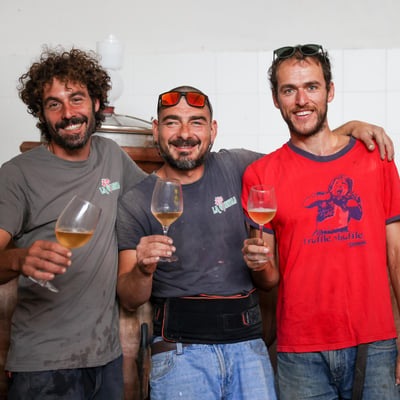
In the volcanic hills of Irpinia, Cantina Giardino (Antonio Di Gruttola & Daniela De Gruttola) has quietly built a living archive of natural wine over the past 20 years. Since their early vintages, they’ve held back bottles, to see what would happen to unsulfured, low-intervention wines over time. Today, their underground sandstone cellar holds one of the clearest proofs that natural wine can not only age, but evolve into something extraordinary.
“Natural wine doesn’t need to be drunk young, … It needs to be made well. If the vineyard is healthy, if the grapes are strong, then the wine has the structure to evolve. It just needs time.”

The transformation is striking. Wines that start out wild or textural often gain precision, minerality, and aromatic focus with age :
- Fiano becomes finer and more vertical, layered with citrus oil and smoke.
- Coda di Volpe, often overlooked, develops honeyed, saline complexity.
- Old-vine Aglianico, rooted in volcanic soils, keeps its power but sheds rusticity, revealing dried herbs, black fruit, and earthy length.

"A wine that seemed chaotic in the first year becomes something else entirely,” they said. “It settles. It speaks more clearly.” This is not just intuition. In collaboration with a university thesis project, they vinified a single Fiano harvest and aged it in stainless steel, gres amphorae, acacia, mulberry, and chestnut barrels.
Each material altered the wine’s arc:
- Amphora oftened edges and heightened salinity.
- Acacia lifted aromatics,
- Mulberry brought sweet spice.
- Chestnut a traditional Campanian wood, added gentle oxidation and tannic backbone.
Cantina Giardino’s wines prove a simple truth: when wine is made with patience and care, time doesn’t take away, it adds.