July 14, 2026 - 0 comments
Vine Braiding: Backbreaking Work for a Season of Freedom
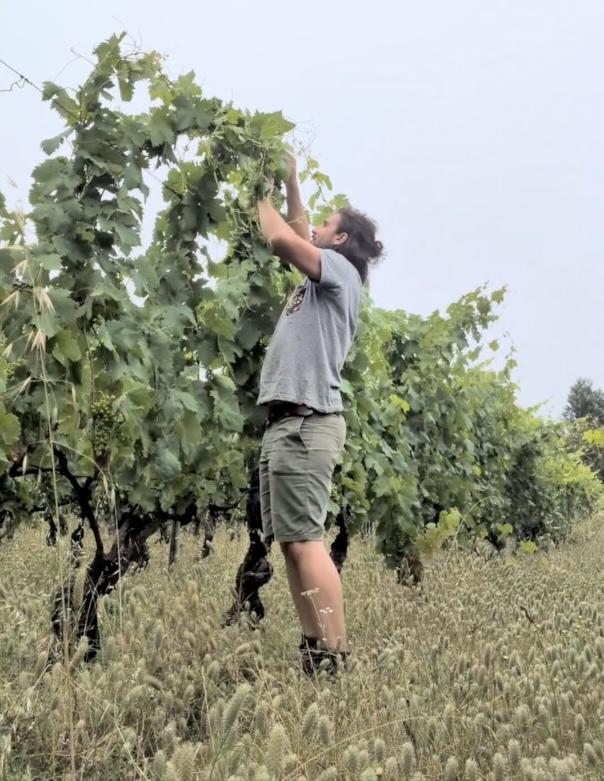
In Portugal's Dão region, a French winemaker takes the time to do what almost no one does anymore. Row after row, he braids the shoots by hand. It is long. It is physical. And it may be one of the most underestimated vineyard practices there is.
What Braiding Really Means
Braiding is not tying. Nor is it trimming. Trimming means cutting the ends of the shoots (the green stems of the year, which carry the leaves and the bunches) that grow beyond the canopy: the usual practice, done by tractor, quickly and repeatedly throughout the summer. Braiding is something else: winding these stems around one another, using their tendrils (the small spiral structures the vine naturally produces to cling to its support). Once intertwined, they hold each other in place. The vine gains structure without needing to be cut. The apexes (the growing tips of the stems) rise higher. The vine exposes more leaves to the sun.
The result is immediately visible: straighter, more open, brighter rows.
What It Prevents
What is less visible is what braiding prevents. When the vegetation is well held in height, lateral shoots develop less. Lateral shoots are the secondary shoots that grow from the leaf axils: unwanted vegetation that clutters the vine, blocks air flow, and competes with the bunches. The fewer there are, the better the air circulates around the grapes. Downy mildew and botrytis (two fungi responsible for rot, feared by every organic winegrower) have less opportunity to take hold.
In organic viticulture, limiting their development upstream is better than treating the problem afterward. And since copper and sulfur (the only fungicides authorized in organic farming) must physically reach the bunches to be effective, open and well-aerated vegetation also means an application that does not get lost along the way.
Why Almost No One Does It
Charlotte Hugel and Paul Chevreux, who have been based in the Dão since 2019, say it plainly: braiding is probably the most painful and time-consuming job of the year.
Hands constantly raised, across entire rows, without breaking the stems. All while trying not to damage what is being built. And the trellising (the structure of wires and posts that supports the vine) also needs to be strong enough: once braided, the vegetation becomes very heavy, and a fragile trellis will not hold the weight.
Topping and trimming, on the other hand, are done by tractor. Quickly. Cleanly. That is why almost everyone has moved on to them. That is why braiding has almost disappeared.
But Once It Is Done
This is where the calculation changes. Trimming means one pass. Then another. Then another again, until August. The vine grows back, you return, you cut again. Braiding, by contrast, is a one-time investment. When done properly, it drastically reduces manual interventions for the rest of the season.
There is one condition, however: debudding must have been carried out seriously beforehand. Debudding is the springtime gesture: removing part of the young shoots by hand so the vine does not grow in every direction. There is no point braiding a vine that is growing all over the place. The two practices go hand in hand.
What It Changes in the Glass
The impact does not stop in the vineyard. It reaches all the way to harvest.
With more exposed leaves and more mature leaves, sugar ripeness (the sugar level in the grapes) is slightly delayed. Phenolic ripeness, on the other hand, moves forward. Phenolic ripeness is the ripeness of tannins and aromas: the moment when the grape is no longer simply sweet, but becomes complex, balanced, and complete. In concrete terms: it becomes possible to wait longer before harvesting, without risking grapes that are too sweet or too soft. The grapes reach full maturity while keeping freshness.
For Charlotte and Paul, harvest usually falls in late September or early October, at around 13% alcohol. Ripe, aromatic wines that keep a taut line. Exactly the style they are looking for.
In the context of climate change, it is also a concrete response: not suffering through runaway ripening, but steering it. Braiding is not a nostalgic practice. It is an adaptation.
Charlotte Hugel & Paul Chevreux — Vizinho Vinhateiro
Charlotte is from Alsace, Paul from Franche-Comté. Charlotte Hugel and Paul Chevreux settled in the Dão after spending several years exploring the region. Their first commercial bottles came from the 2021 vintage.
They work two and a half hectares under lease, and buy roughly the same quantity of grapes from three owners in the village: a 50/50 balance for now. The vines are farmed according to the principles of organic farming, with copper and sulfur, without certification for the moment. They also make a few homemade preparations: chamomile tea, fermented nettle extract, notably to help the vines through drought, and whey as a preventive measure against powdery mildew. The soil is no longer worked; their mares, Bonita and Kata, graze the grass during winter.
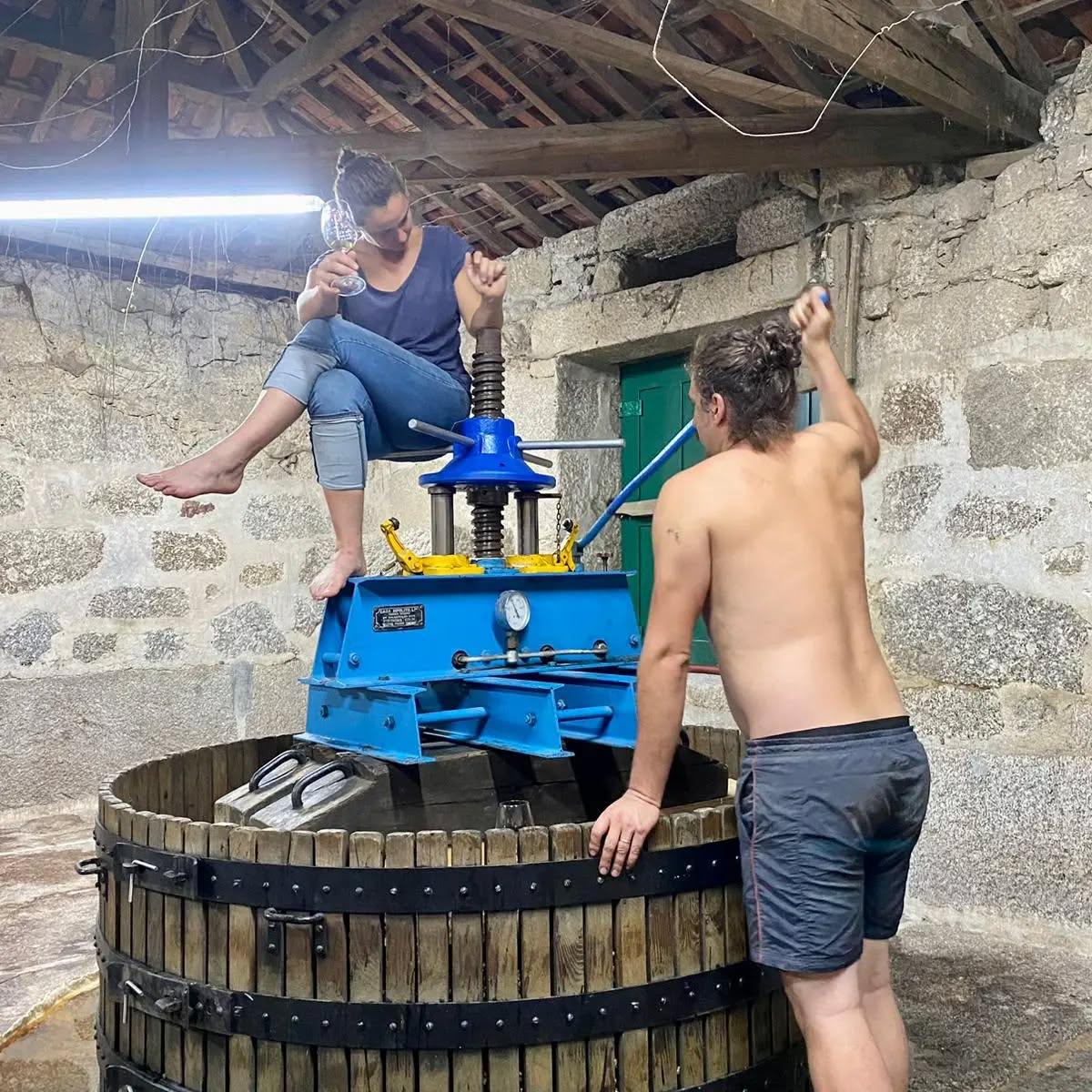
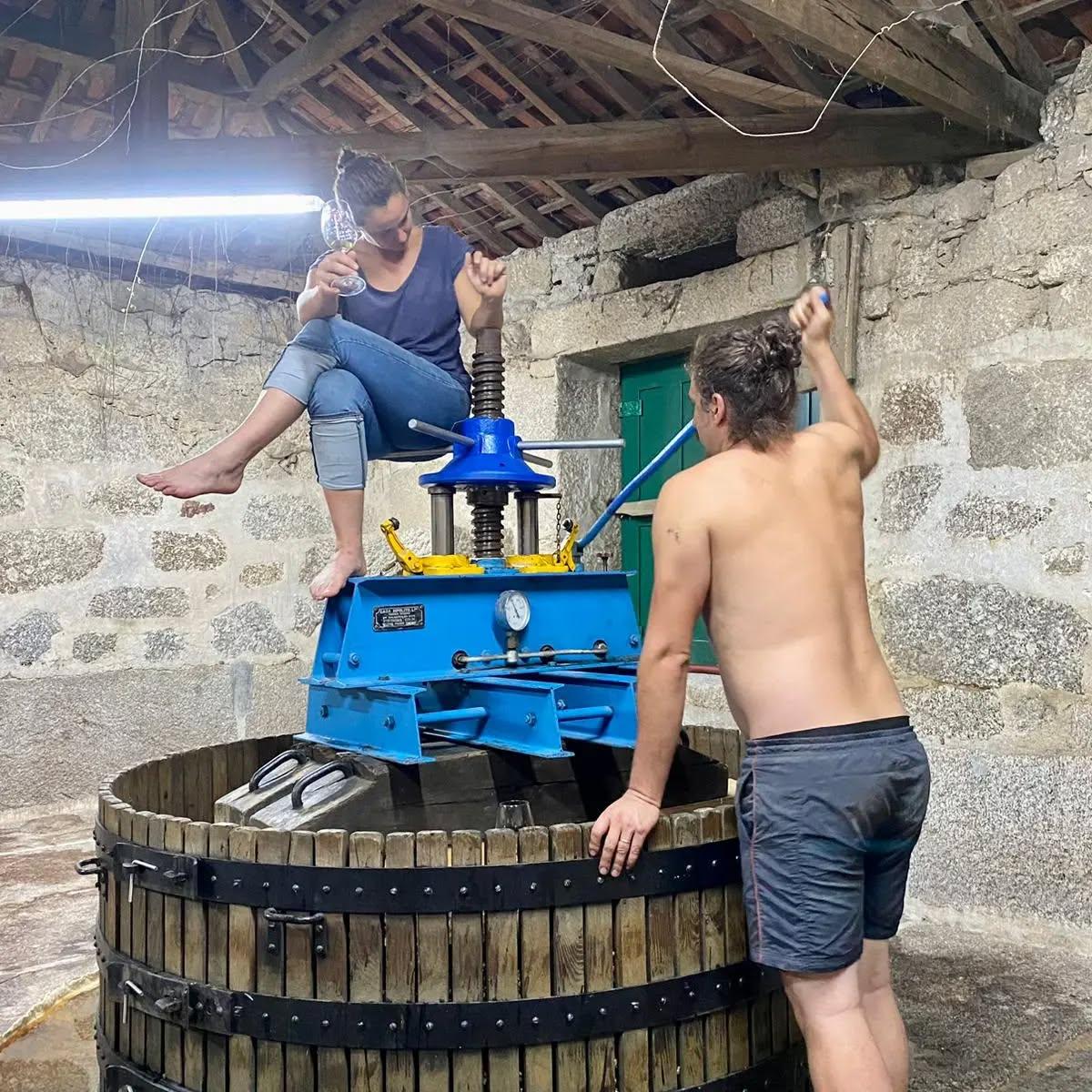
In the cellar, the whites ferment in used barrels after vertical pressing. The clarets (a short-maceration wine, halfway between a light red and a rosé, typical of the region) are macerated and foot-trodden in centuries-old granite vats for seventy-two hours before they too move into wood for fermentation. The reds follow a more classic pattern, going into barrel after alcoholic fermentation. Sulfur is used thoughtfully, depending on the vintage. No other additives.
The grape varieties reflect the richness of the Dão: Clarete, Baga, Pinot Gris, Arinto, Arinto Roxo, Bical, Fernão Pires, Tinta Roriz, Tinta Carvalho, Touriga Nacional, Jaen, Alfrocheiro. Most of them are native Portuguese varieties, grown together in the same plot: what is known as a field blend.