December 04, 2025 - 0 comments
QR codes on wine: what they tell you (and, more importantly, what they don’t)
Since December 8, 2023, all wines produced in the European Union must display their ingredients and nutritional values. A small revolution? Not so fast. What does NOT appear on these QR codes is at least as interesting as what does.
The context: transparency at last (well, almost)
With EU Regulation 2021/2117, wine finally loses its long-standing exception. Like all food products since 1979, it now has to put its cards on the table. In theory, it’s simple: scan the QR code; you see what’s in your bottle.
For natural vignerons who use only grapes and a touch of sulfur, it’s the perfect opportunity to highlight the simplicity of their approach. For everyone else… it’s more complicated.

What the law says
The new regulation requires the display of:
- The full list of ingredients: grapes, sucrose or concentrated must (in case of enrichment), and all enological additives
- Energy value: mandatory on the physical label
- Full nutrition declaration: via QR code or on the label
Enological additives? The European Union authorizes nearly 300 substances in the production of conventional wine. Acidity regulators, preservatives, antioxidants, stabilizers, fining agents, enzymes, industrial yeasts… enough to fill several pages. Hence the usefulness of the QR code.
What the law doesn’t say
And here’s where it gets interesting. The European regulation relies on the FIC regulation (Food Information to Consumers), which defines precisely what an “ingredient” is. This definition creates a crucial distinction:
Food additives = ingredients → must be listed Processing aids = not considered ingredients → must NOT be listed
What is a processing aid? A substance used during production that’s “not supposed to remain in the final product” (or only in trace amounts).
This includes, for example:
- Selected industrial yeasts
- Fermentation enzymes
- Clarifying agents (bentonite, isinglass, egg white, etc.)
- Certain stabilizers
- Yeast nutrients
The problem? These substances profoundly modify the wine. They influence taste, texture, stability, and the aromatic profile. But because they are supposed to disappear (even if residues may remain), they escape labeling requirements.
A concrete example
Let’s take two bottles:
Bottle A (conventional):
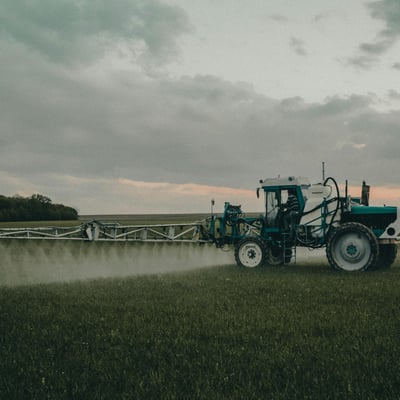
- Grapes treated with synthetic pesticides
- Mechanical harvesting
- Chaptalization (addition of sugar)
- Selected industrial yeasts + yeast nutrients
- Extraction enzymes
- Acidification or deacidification
- Fining with bentonite
- Cold tartaric stabilization
- Sterile filtration
- Addition of SO2 at several stages
What the QR code says: “Ingredients: grapes, sucrose, acidity regulator (tartaric acid), preservative (sulfites)”

Bottle B (natural):
- Organic or biodynamic grapes
- Hand harvesting
- Fermentation with native yeasts
- No enological inputs
- No filtration or very light filtration
- Minimal dose of sulfur (or none)
What the QR code says: “Ingredients: grapes, preservative (sulfites)”
The two QR codes look alike. The two wines have nothing to do with each other.
Why this distinction is problematic
Officially, processing aids are not ingredients because they don’t remain in the finished product. In reality:
- Residues can persist (even at very low levels)
- Their impact on the wine is major and definitive
- The consumer has no way of knowing whether they were used
It’s like selling you orange juice that lists “ingredients: orange juice.” In reality, the oranges were treated with enzymes to extract more juice, the liquid clarified, stabilized, pasteurized, then sometimes “re-flavored” with natural orange aromas recovered during the process.
Technically true. Practically misleading.
The system’s gray areas
Some enological products sit on the border between the two categories. Example: gum arabic. It’s an additive (so it must be mentioned) when it’s used to stabilize color. But it’s a processing aid (so not mentioned) when it helps with clarification.
Result: two wines can use the same substance, and only one will show it on its QR code, depending on the declared use at the time of addition.
The natural wine philosophy
Natural vignerons sidestepped this legal debate decades ago. Their approach is radically different:
No inputs = no Byzantine distinctions between additives and processing aids
When you make wine with:
- Healthy grapes grown without synthetic chemistry
- The yeasts naturally present on the berries
- No enology products
- A minimal dose of sulfur (or none)
… The question of what must be mentioned or not no longer arises. There’s nothing to hide because there’s nothing to declare.
Raisin’s generator: go further
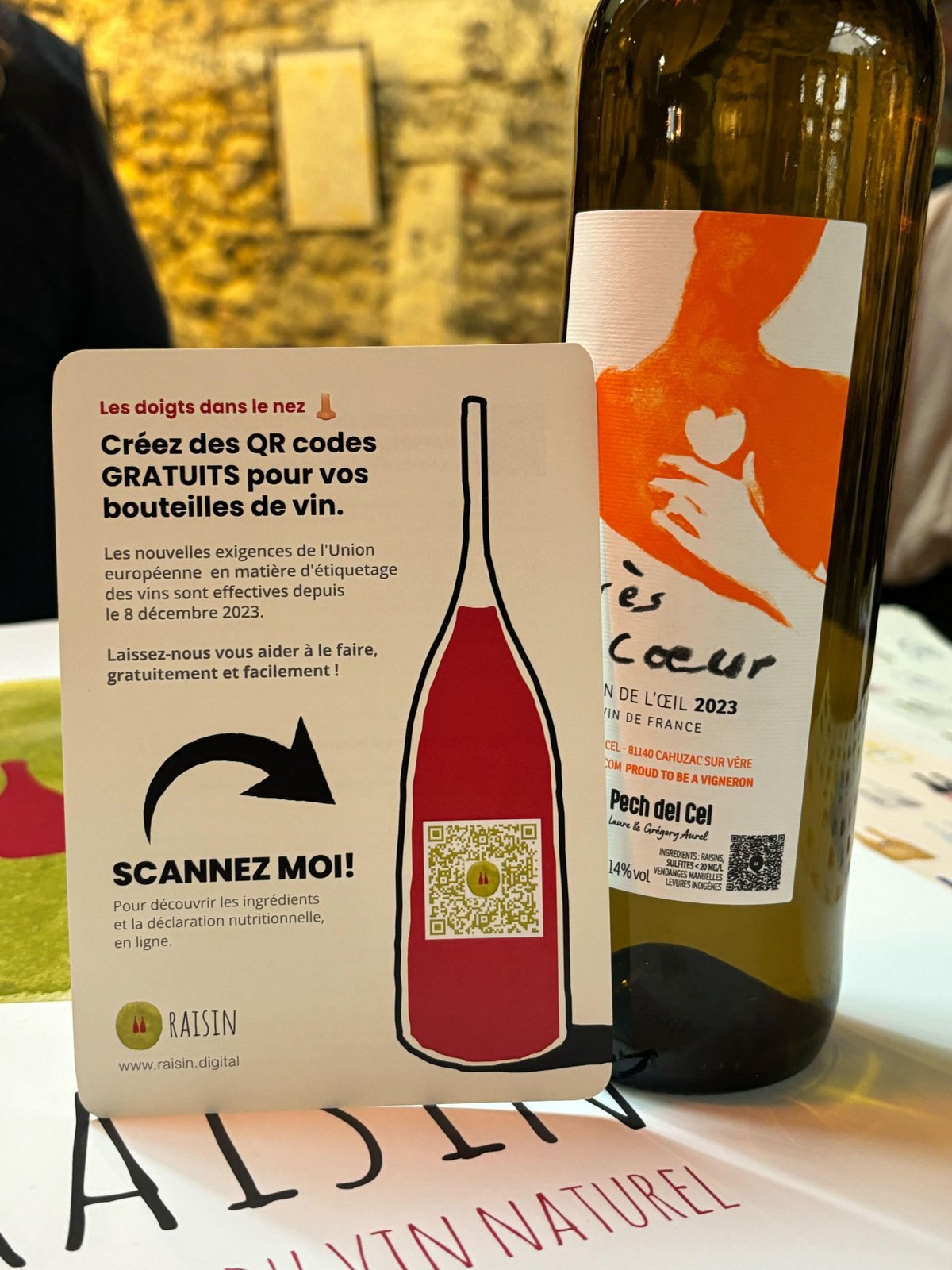
At Raisin, we created a free QR code generator specifically for natural vignerons. Not to “tick a regulatory box,” but to turn this legal obligation into an educational opportunity.
We already have a database of more than 225,000 natural wines with all their characteristics (grape varieties, colors, estates). All that’s left is to complete the regulatory information. Create a compliant QR code in 4 steps. No sweat. With natural wine.

What we’d like to see evolve
The current regulation is a first step. But for true transparency, we’d need to:
- Clearly distinguish wines by their practices: an official “natural wine” logo guaranteeing the absence of inputs
- Require the mention of major processing aids: at least those with a significant impact on the finished product
- Ban misleading wording: an ultra-technological wine shouldn’t be able to show only “grapes + sulfites”
In the meantime, the simplest choice for consumers remains natural wine. Not because the law demands it. But because it’s the only approach where you know exactly what you’re drinking.
Conclusion
QR codes on wine bottles are better than nothing. They’re even a significant step forward compared to the total opacity we had before. But there’s still a sizeable gap between legal transparency and real transparency.
Natural vignerons bridged that gap long ago. Not by playing with regulatory definitions, but by simply making wine the way it should always be made: with grapes, time, and know-how.
Because in the end, true transparency isn’t what you’re obliged to say. It’s what you’re proud to show.
Want to know more?
- Discover our free QR code generator on raisin.digital
- Download the Raisin app to scan wines and check if they’re natural on Google Play and on the App Store
- Join 500,000+ enthusiasts who have chosen transparency
Are you a natural vigneron and want to be listed? Find out how to sign up on Raisin.