April 09, 2026 - 0 comments
La Stoppa: What if the legal limit of volatile acidity no longer made sense?
"Vinegar has no impact on health. So why should we have this limit?" Elena Pantaleoni, La Stoppa
There are rules in wine that seem unquestionable. Volatile acidity is one of them. Too much acetic acid in a glass, and the verdict is immediate: major fault, non-marketable wine, batch to be discarded. The regulatory limit of 20 meq/L, roughly 1.2 g/L of acetic acid according to OIV standards, applies across Europe and, more or less, worldwide.
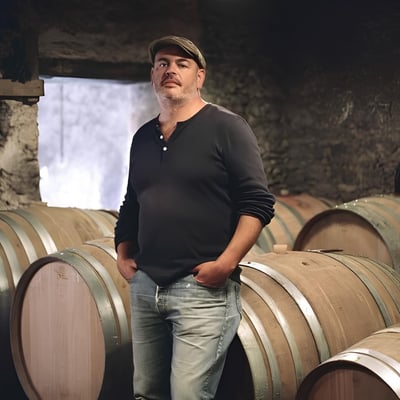
But Elena Pantaleoni, winemaker at La Stoppa in Emilia-Romagna, sees it differently. What if this limit was arbitrary?
A protective tool that became a constraint
Volatile acidity, mainly made up of acetic acid, the same compound found in vinegar, forms naturally during fermentation and aging. It increases over time, with heat, and with the presence of certain bacteria. And this is where the issue goes far beyond marginal winemaking.
This is not just about natural winemakers. In France, several ODGs, organizations that represent appellation producers and defend their rules with the INAO, have already submitted official requests to raise this limit. Côtes de Bergerac, for example, requested the right to reach 25 meq/L for certain sweet white wines, where residual sugar inevitably encourages higher acetic acid levels. These requests are formal, documented, and regularly discussed within professional bodies.
Climate change is amplifying the situation. Warmer summers accelerate grape ripening, reduce natural tartaric acidity, and encourage the development of acetic bacteria. Entire appellations are now reaching the legal threshold not because of poor practices, but because climate conditions have evolved faster than regulations.
Health as an argument, taste as the real debate
The health argument behind this legal limit is based on two points: microbial risk and organoleptic defect, in other words, a vinegar-like taste. But Pantaleoni dismisses one of them: "Vinegar has no impact on health." What remains is taste. And that is where things become subjective.
A noticeable volatile acidity is not automatically a flaw. In a balanced wine, where structure, texture, and freshness interact, it can bring complexity. Pantaleoni’s example of her Malvasia is telling: in this white wine with naturally low tartaric acidity, volatile acidity contributes to drinkability and tension. It is not a winemaking accident, it is part of the style.
The issue, she says, is only when it dominates everything else: "If you only smell volatile acidity, it’s not good."
Her analogy is simple and striking. "Wine, like people, needs balance. You don’t judge a person because they have grey hair." One single characteristic does not define the whole. Judging a wine based on one chemical parameter, without considering its overall harmony, misses the point.
Regulation that no longer reflects reality
What Elena Pantaleoni raises goes far beyond La Stoppa or natural wines. It reflects a deeper tension between regulations designed for a different climate context and the reality of winemakers working with hotter summers, riper grapes, and increasingly difficult fermentations, whether they are organic, biodynamic, natural or conventional.
The current limit, set decades ago, was not designed for today’s conditions. And the growing number of exemption requests submitted to the INAO is a clear signal: this is no longer a marginal concern, but a question the entire industry is starting to take seriously.
Seeing wine as a whole
What Elena Pantaleoni ultimately defends is not the right to make vinegar. It is the right to be judged for what a wine is, not for what a single number says about it.
"A good bottle must be seen as a whole." And what if, instead of relying on a regulatory limit set decades ago, we simply let consumers decide what is drinkable?