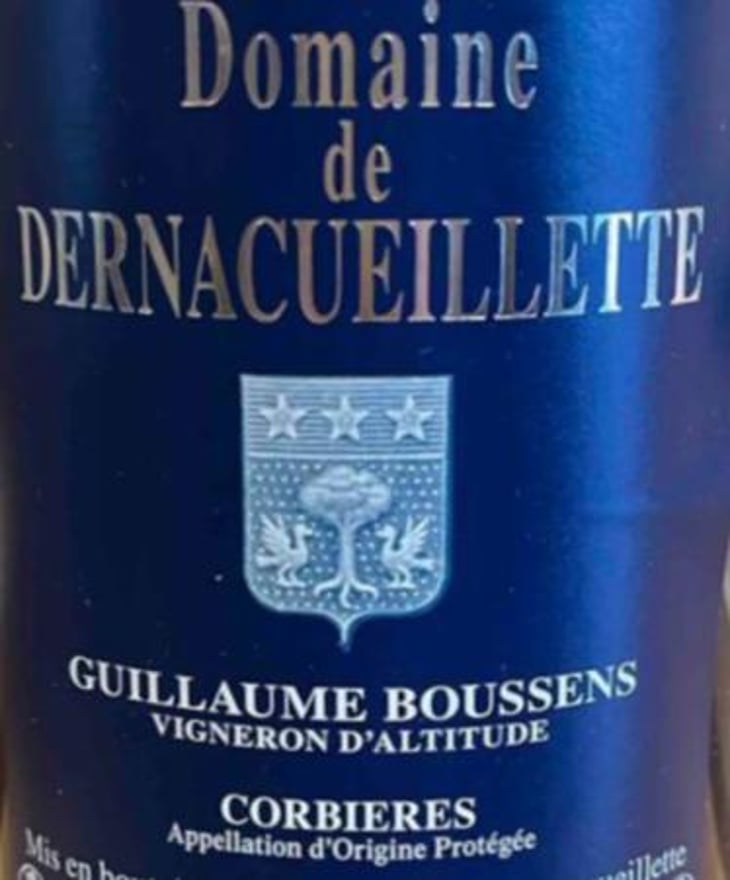
Domaine Dernacueillette - Guillaume Boussens
The vineyard is located on the terroir of Termenès,
in the high Corbières (altitude 460 - 680m),
on the back of Mont Tauch (Mount Ifs).
This altitude gives the vineyard a climate
unique and ideal conditions, a maturing
slow grapes.
Discovery of the vineyard in November 1999, Guillaume Boussens takes over the exploitation in 2000. The harvest
2000, 2001, 2002 are brought to the cooperative cellar. The first cellar harvest was held on the 28th
September 2003. The restoration of the exploitation, operates over the last thirteen years.
We work in perfect symbiosis with nature, without excessive human intervention, for a better
respect the environment.
Between the soil and the plant we bring to this vine a cultural balance as natural as possible. The winemaker
behaves like a homeopath of the vine.
All the work on the plant is done by hand:
-Maintained vegetation,
-Epamprage,
-Trimming the vines with shears once or twice a season, in
according to the grape variety,
-Lawn and burial of the branches allow a lesser
soil erosion and maintain macro and microbial soil life
(living soil) "Attention here there is life! "
-Manual fertilizer application controlled on demand every 3 to 5 years.
We do between 3 and 4 treatments a year (wettable sulfur,
micronized sulfur, Bordeaux mixture). On the other hand, we do not
no acaricide, no insecticide, no anti botrytis on the vines
(Because of its geographical location), nor any anti germinative in
the grounds.
Faced with the enormous pressure of the wild boar, the parcels are all fenced and electrified.
The wines are bred in a lightning of 50hl (Stockinger), in half-muids of 6hl, and in low concrete vats.
volumes to protect the fruit and refine the tannins by mastering the natural reduction of the wine.
The wines are aged on fine lees, and are withdrawn in the spring, depending on oxygen requirements.
The farms are long, and no need for collage. They are filtered very lightly.
A very discreet sulphiting is done before filtration and bottling. It will be no or very little detectable at
chemical and organoleptic analysis.





 Winemakers
 Restaurants
 Bars
Bars Wine Shops
 Accommodations
 Events