When is Beaujolais Nouveau released?
By decree, Beaujolais Nouveau is released every year on the third Thursday of November. In 2025, this date falls on a Thursday, November 20. Beyond the folklore, this day marks the first tasting of the vintage: a sincere, fruity primeur wine that sets the tone for the year. And we love that!
| Year | Date (3rd Thursday in November) |
|---|---|
| 2025 | Where to Celebrate the Arrival of “Beaujolais Nouveau and Primeur Wines”? |
| 2026 | Thursday, November 19, 2026 |
| 2027 | Thursday, November 18, 2027 |
| 2028 | Thursday, November 16, 2028 |
| 2029 | Thursday, November 15, 2029 |
| 2030 | Thursday, November 21, 2030 |
| 2031 | Thursday, November 20, 2031 |
| 2032 | Thursday, November 18, 2032 |
| 2033 | Thursday, November 17, 2033 |
| 2034 | Thursday, November 16, 2034 |
Origins: a wine for thirsty farmers
Before becoming a global phenomenon, Beaujolais Nouveau was first and foremost a wine of necessity. In the granite hills between Mâcon and Lyon, winegrowers cultivated Gamay Noir à Jus Blanc, a generous, productive, and fast-ripening grape variety. It was ideal for small family farms, which were often economically fragile.

After World War II, the Beaujolais region remained poor. Most producers sold their wine to merchants in Lyon or Burgundy, and they needed immediate cash to make ends meet. Waiting months, or even a year, before selling the finished wine was a luxury that few of them could afford. So the idea is simple: put the wine in barrels as soon as fermentation is complete, deliver it, collect the money, and breathe a little easier financially, so you can head into winter with greater peace of mind. “New” wine, also known as “primeur” wine, is a source of income for farmers long before it is a symbol of celebration.
But this early wine was not just an accounting solution: it was also a wine for conviviality. Served in the bouchons of Lyon and the cafes of Beaujolais, it accompanied pork dishes, grattons, salads, and everything else that the region had to offer in terms of hearty and cheerful fare. It was drunk from a pot lyonnais (a thick-bottomed bottle with a capacity of 46 centiliters), slightly cloudy, a little chilled, with the satisfaction of a job well done and the simple pleasure of the moment. It is this dual nature, both economical and popular, that explains the survival and expansion of Beaujolais Nouveau. A wine designed to be gulped down, born out of necessity, has become a symbol of spontaneity. And it is precisely this “immediate” character that négociants would later transform into a global phenomenon... With the excesses we are all familiar with.
1950-1980: From Local to Global Phenomenon

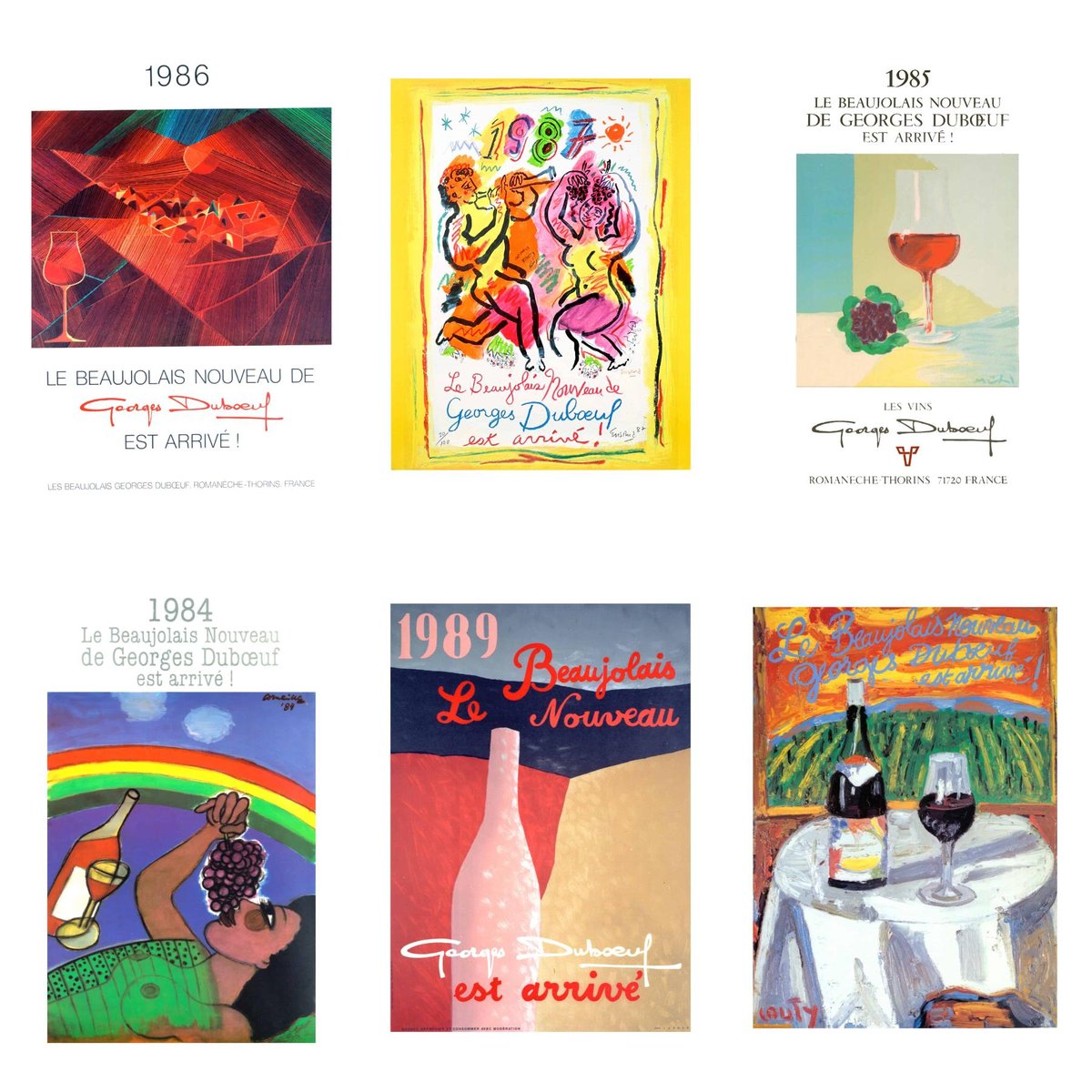
Beaujolais Nouveau posters by Maison Georges Duboeuf
For each vintage, Georges Duboeuf calls upon an artist to create a poster that also serves as the bottle label. With its “collectible” aspect, this label clearly identifies each event as a unique moment. See all the posters on the Georges Duboeuf website. All rights reserved.

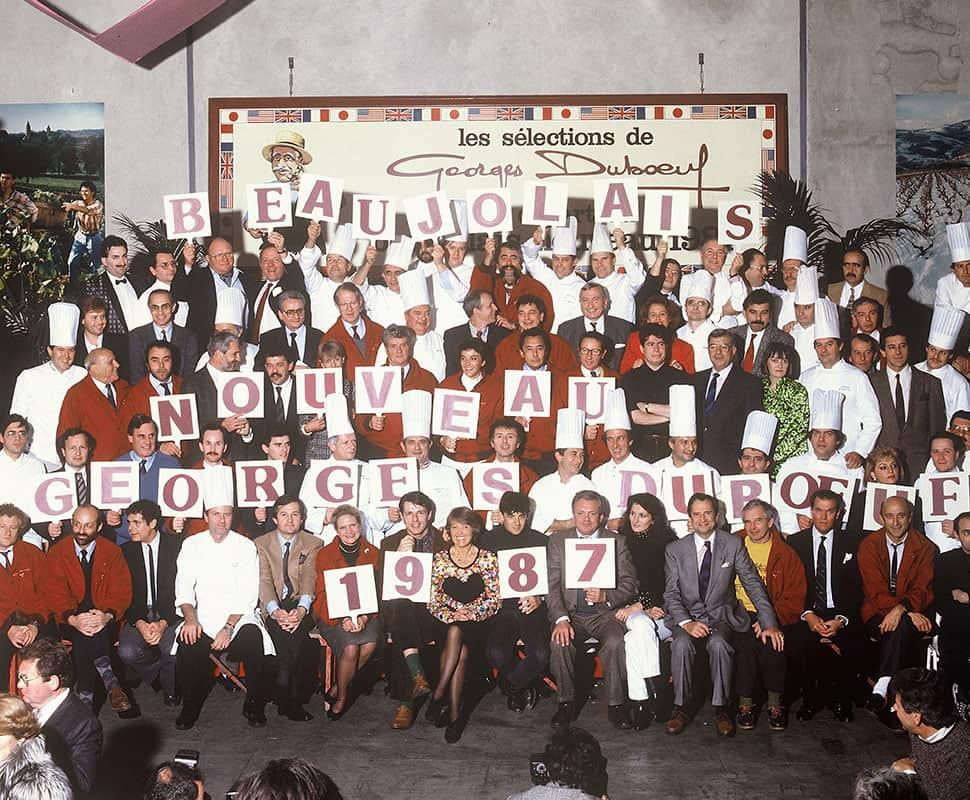
Lyon and Beaujolais wine merchants: the previous generation
But before Georges Dubœuf, in the 1940s and 1950s, there were already several local wine merchants who had recognized the potential of primeur wine:
- Louis Jadot, Joseph Drouhin (Burgundy houses), who sold Beaujolais as an entry-level wine
- Not to mention the négociants of Villefranche-sur-Saône, such as Trenel, Potel-Aviron, and Mommessin, exported small volumes to Switzerland and England from the late 1940s onwards.
- Finally, the Beaujolais cooperatives, created to pool production and transport costs, also played a key role in regional distribution before internationalization.
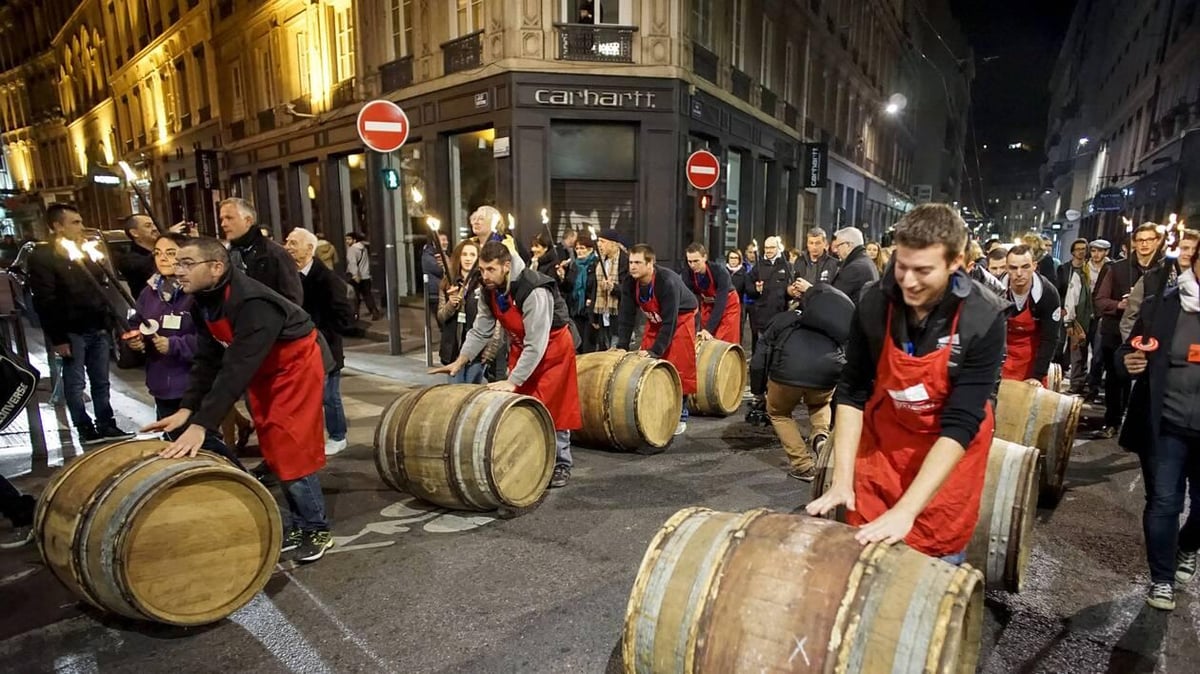
But it must be said: before Dubœuf, Beaujolais remained a local wine. The first “Beaujolais Nouveau runs to Paris,” when trucks would leave at midnight to deliver to the capital's bistros, dates back to 1951. Paris," trucks that left at midnight to deliver to the capital's bistros, date back to 1951-52, shortly after the liberalization of the sale of primeur wines (the INAO officially authorized their early sale in 1951).
The British and Japanese: catalysts of fashion
In the 1970s and 1980s, it was British importers (notably Berry Bros. & Rudd) and Japanese distributors (notably Suntory and Kikkoman Wine Co.) who amplified the phenomenon. In Japan, launch campaigns were orchestrated like pop culture events, with TV commercials, competitions, and even Beaujolais baths in onsen « hot springs » 😅. These markets love the idea of the “first wine of the year”: festive, affordable, immediate. The concept itself is brilliant.
| Decade | Main actors | Role |
|---|---|---|
| 1940-1950 | Cooperatives and merchants in Lyon | Regional distribution and first shipments to Paris |
| 1950-1960 | Georges Dubœuf | Structuring, strong brand, global communication |
| 1970-1980 | British and Japanese distributors | Explosion in international demand, marketing success |
| 1990 - 2000 | Traditional producers and merchants | Overproduction, decline in quality, and loss of public interest |
| 2000-2020 | Natural winemakers (Lapierre, Foillard, Métras, etc.) | Renaissance in quality and return to original values |
The taste of banana: why and how?

Success calls for speed. To produce quickly, in large quantities, and to “please everyone,” winemaking has been standardized: selected yeasts known as “aromatic,” controlled temperatures, strict filtration, etc. The result: aromatic," controlled temperatures, strict filtration, etc. The result: wine has become uniform. One marker of this standardization is the use of isoamyl ester, a naturally occurring compound formed by the reaction of an acid with an alcohol. It is a colorless liquid with a very recognizable smell of ripe banana or “Arlequin” candy. It is these isoamyl esters that gave many wines from the 1980s and 1990s an artificial banana-candy aroma, which, despite itself, became the signature of an era. Wine lost its accent, its nuance, its vibrancy. Volumes exploded, quality declined, and quantity and overproduction were prioritized. We rushed headlong into the bad.
Excesses and overproduction: the hangover
The marketing bubble is growing: overproduction, stockpiles, erratic quality, sometimes undrinkable. The image is blurred to the point of absurdity: Beaujolais baths in certain spas in Japan, costumes, and happenings border on the ridiculous and overshadow the wine. Little by little, enthusiasts are turning away, and Beaujolais Nouveau is becoming a subject of humor; its quality makes it a laughing stock, and it becomes the easy joke of the bar. Sales plummeted... as did profits. Below is the curve of Beaujolais Nouveau sales volumes, by decade, since 1951:
Volumes sold of Beaujolais Nouveau, by decade, since 1951:

What the curve shows (1951 → 2024)
- ~1951: ~15,000 hl = (early 1950s), modest start after the 1951 exemption.
- 1967: > 200,000 hl = significant acceleration.
- 1985: ~ 500,000 hl (peak) = media and commercial heyday.
- 2005: ~ 450,000 hl = still a very high figure at the end of the millennium and in the early 2000s. 2022: 53,376 hl = collapse in volumes recorded by customs.
- 2023: ~120,000 hl sold = relative recovery (“sold” figure).
- 2024: ~105,000 hl sold = further decline expected for 2025
Natural renaissance: the return of life!
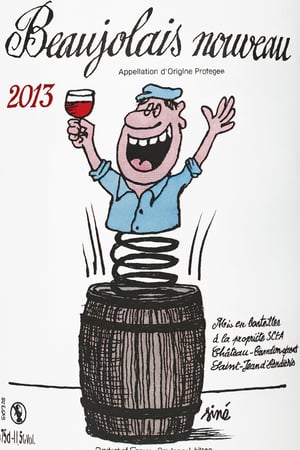
In the early 1980s, a new phenomenon took root. Amidst the turmoil, a handful of winemakers decided to return to basics. Led by figures such as Marcel Lapierre, Jean Foillard, Yvon Métras, Julie Balagny, Charly Thévenet, Beaujolais Nouveau is back to its roots: controlled carbonic maceration, indigenous yeasts, a light dose of sulfur, gentle extraction, and careful bottling. Natural Beaujolais Nouveau is arriving on the scene and claiming superior qualities.
The result? Juicy, straightforward, vibrant primeurs — finally with their touch of terroir again. In 2025, we can honestly talk about a renaissance. No, Beaujolais Nouveau is not doomed to taste like candy or banana. Yes, it can be natural, precise, delightful, and excite both amateurs and the most demanding experts.
Where to taste a natural Beaujolais Nouveau
The go-to grape for bars, cellars, restaurants, and events committed to natural wine around the world. In Paris, Lyon, Brussels, Rome, New York, Tokyo... the celebration is enjoyed with well-made wines and teams who know how to serve them.
- When is Beaujolais Nouveau 2025? Thursday, November 20, 2025 (third Thursday in November).
- What is Beaujolais Nouveau?
- What is a Natural Beaujolais Nouveau? ... and where to find it!
- Are you organizing an event for Beaujolais Nouveau this year? (register)
- Where to celebrate the arrival of ”natural Beaujolais Nouveau and primeur wines?
- Find all the natural winemakers in Beaujolais on our website and on our map.
Quick FAQ
- Does Beaujolais Nouveau always taste like bananas? No. This aroma mainly came from standardized winemaking techniques used in the 1980s and 1990s. Today's natural Beaujolais Nouveau wines express the fruit of the Gamay grape without any artificial additives.
- Why continue to celebrate Beaujolais Nouveau? Because it is the first breath of the vintage: a wine for sharing that tells the story of the year. When done well, it is a simple and pure pleasure.
- How can you recognize a natural Beaujolais Nouveau? Clues: indigenous yeasts, sometimes a slight dose of sulfur, clean work in the vineyard and cellar, winemakers listed in Raisin, and establishments that clearly communicate the “nouveau” natural Beaujolais.
Unusual: Beaujolais Nouveau at Yunessun Thermal Park
Every autumn, on the third Thursday of November, Yunessun Thermal Park in Hakone, near Tokyo, attracts media attention with its Beaujolais Nouveau bath. This unusual experience, often reported in France, is part of a well-established Japanese tradition: aromatic baths. In a country rich in natural hot springs, it is not uncommon to soak in pools scented with apple, rose, or citrus, which are believed to have skin benefits. At Yunessun, the red wine bath is one of the main attractions, along with the coffee bath. The mixture consists of thermal water, a coloring agent, and a small amount of alcohol. Since 2005, two weeks after the official release of Beaujolais Nouveau, it has been replaced by the real vintage wine. Three times a day, an employee symbolically pours a few bottles into the pool, under the amused gaze of visitors; some even try to taste it despite warnings. More than a true cultural tradition, these Beaujolais baths are above all a successful marketing operation, combining the pleasures of thermalism, folklore, and curiosity about French culture. We promise we won't ask anyone what we would find in these baths if we carried out thorough analyses...